FERS Retirement Guide
Understand the Federal Employees Retirement System, its basic components, eligibility requirements, and retirement considerations.
Read GuideExplore independent educational resources covering FERS, CSRS, TSP, FEGLI, federal retirement eligibility, annuity calculations, and retirement planning.
Six starting points covering the core programs and planning questions federal employees most often ask about.
Understand the Federal Employees Retirement System, its basic components, eligibility requirements, and retirement considerations.
Read GuideExplore the Civil Service Retirement System, historical coverage, service requirements, and annuity concepts.
Read GuideLearn about high-3 average salary, creditable service, annuity formulas, and retirement estimates.
Read GuideUnderstand Federal Employees' Group Life Insurance, coverage options, and retirement considerations.
Read GuideLearn about the federal retirement savings program, contribution concepts, and withdrawal options.
Read GuideExplore preparation checklists, important documents, retirement timelines, and planning considerations.
Read GuideShort, focused articles that answer one question at a time.
How the age and years-of-service rules work together, and why the minimum retirement age matters for planning.
Read ArticleA side-by-side look at contributions, benefit structure, and Social Security coverage under each system.
Read ArticleWhat the high-3 average is, how it is calculated, and why unpaid leave and salary changes can affect it.
Read ArticleWhy federal life insurance coverage can change at retirement and what to review while you still have time.
Read ArticleA plain-language overview of the general withdrawal categories and the timing questions that come with them.
Read ArticleThe records worth gathering early, from service history to beneficiary forms, so nothing is rushed at the end.
Read ArticleFederal employees in the United States have generally been covered by one of two government retirement systems: the Civil Service Retirement System (CSRS) or the Federal Employees Retirement System (FERS). Which system applies depends mainly on when a person was first hired into federal service.
FERS is the newer system. It combines three parts: a basic annuity (a defined pension), Social Security, and the Thrift Savings Plan (TSP), a tax-advantaged retirement savings plan similar in concept to a 401(k).
CSRS is the older, pension-focused system. It does not include Social Security coverage for federal service in the same way, and its annuity formula is generally more generous per year of service.
Social Security is a separate federal program. Under FERS, most employees pay into it and may receive benefits from it in addition to their FERS annuity. The TSP is an individual savings account, and its balance depends on contributions, investment results, and withdrawals.
This site explains how these pieces fit together. It does not calculate your personal benefit. For an official estimate, use the resources listed in the section below.
Compare the Systems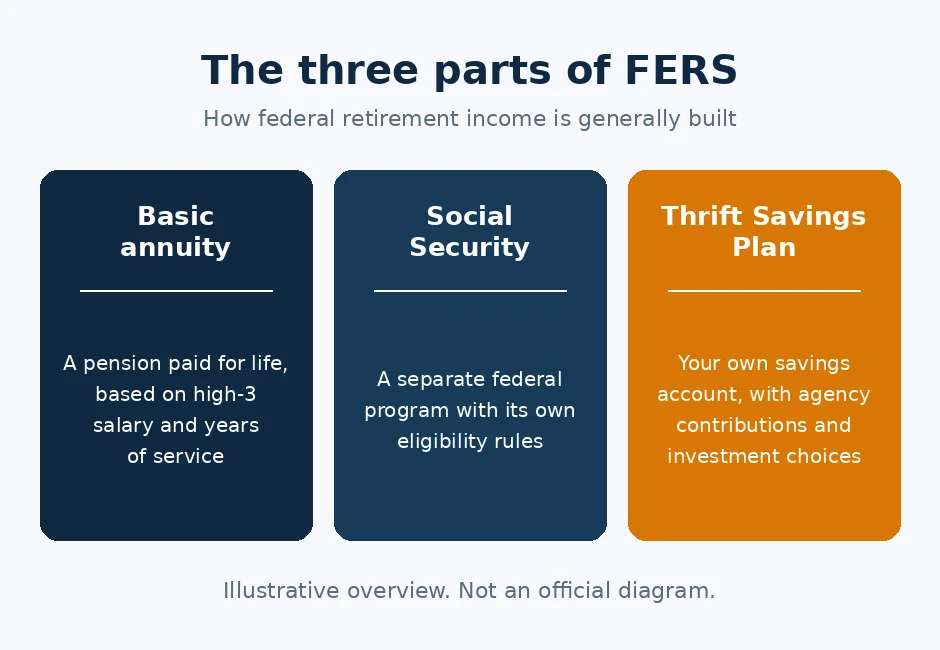
FedRetire Guide is an educational publication. For account access, applications, and official estimates, please use these government and plan websites directly.
Official retirement services information for federal employees and annuitants.
Visit site →The official site for TSP account information, forms, and withdrawal rules.
Visit site →Official information on Social Security benefits and personal earnings statements.
Visit site →Clear boundaries, primary sources, and a visible way to report corrections.
FedRetire Guide is a privately operated educational publication, not OPM or a government service. We do not process applications or access benefit accounts.
Our guides link readers to OPM, TSP, and Social Security for current program rules, forms, and account-specific information.
Content is published by the FedRetire Guide Editorial Team. We do not invent individual authors, professional credentials, or government affiliations.
If you find an error or outdated link, contact the publisher with the page address and the relevant passage.
Begin with the FERS guide if you were first hired in 1987 or later, or the CSRS guide if you were hired before 1984. If you were hired in between, read both guides and confirm your coverage with your human resources office. Each guide explains the terms you will see on official forms.